A gift for
the far side of the Moon
Daedalus crater, which has never once seen Earth.
Why Daedalus
Daedalus lies about 6° south of the lunar equator, right beside the 180° meridian — near the middle of the far side, close to the point directly opposite Earth. The Moon keeps one face turned toward us, and its slow wobble only lets Earth wander within a small patch of the near-side sky. From Daedalus, Earth is always on the other side of the Moon. We have seen it — Apollo 11 photographed it from orbit in July 1969 — but it has never once seen us.
The same shadow that hides Earth makes it quiet. Radio astronomers describe the lunar far side as the only truly radio-quiet zone in the inner solar system, shielded by the Moon itself from Earth's radio noise. Claudio Maccone singled out Daedalus as the crater most shielded from that noise and proposed a radio lab inside it; NASA has studied the FARSIDE array concept; and the NASA–DOE LuSEE-Night radio telescope is built to land on the far side.
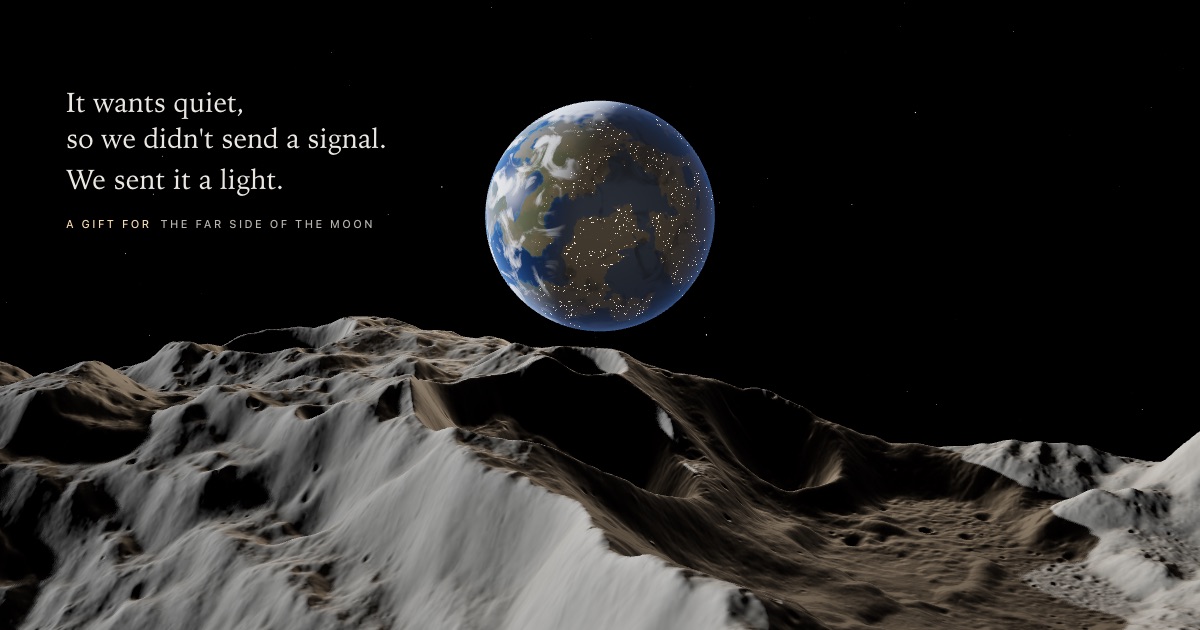
It wants quiet, so we didn't send a signal. We sent it a light.
The piece
 Web Seen from the watcher's seat. Photos of the printed piece go here when they arrive.
- Scale
- 1 mm = 1 km (1:1,000,000)
- Height
- ×3 vertical exaggeration — every real kilometre of relief becomes 3 mm
- Tile
- 180 × 150 mm of real far-side terrain, crater centred
- Plinth
- 192 × 162 × 43 mm, crank on the right
- Crank
- Direct drive, 103.5° of travel, an O-ring brake holds the Earth wherever you stop
- Earth
- Ø32 mm hollow shell, one warm-white LED inside, USB-C, no coin cells
- Watcher
- 22 mm tall — 22 km at map scale
Fairy-tale scale, on purpose. A true-scale Earth would be a 12.74 m ball hanging 384.4 m away. We broke scale for exactly two things: someone to look, and something to see.
Real elevation, no sculpting. The ground is measured from lunar orbit. The arm's shape and travel were computed from sightlines so that, from where you stand, the Earth stays hidden at rest and clears the far ridge when raised.
This web version
It is built from the same files the print shop received: the terrain heightmap, the arm's kinematics and the props' placement. The crank turns the arm through its real travel, and the Earth brightens as it clears the horizon — measured live, from wherever you are looking. Sit on the rim puts you at the watcher's eye; in that view the plinth and mechanism are hidden.
The Earth and the watcher on screen are stand-ins until the final Tripo models are in.
- ↑ ↓
- turn the crank (hold)
- Space
- turn it for me / lower it
- R
- sit on the rim (Esc to leave)
- M I
- sound, this panel
Data & credits
- Topography. SLDEM2015 (LOLA + SELENE/Kaguya Terrain Camera, 512 pixels per degree). Barker, M. K., Mazarico, E., Neumann, G. A., Zuber, M. T., Haruyama, J., & Smith, D. E. (2016). A new lunar digital elevation model from the Lunar Orbiter Laser Altimeter and SELENE Terrain Camera. Icarus, 273, 346–355. doi:10.1016/j.icarus.2015.07.039. Data: NASA LRO LOLA Science Team and JAXA SELENE (Kaguya), via the NASA PDS Geosciences Node.
- Cross-check. Registered against NASA's Scientific Visualization Studio CGI Moon Kit (LOLA, 64 pixels per degree). Credit: NASA's Scientific Visualization Studio; LOLA Science Team.
- Names. IAU/USGS Gazetteer of Planetary Nomenclature. The title references Earthrise, taken by Bill Anders from Apollo 8 on 24 December 1968; no NASA imagery is reproduced here.
- Software. three.js (MIT) and the meshoptimizer decoder (MIT). Sound is generated in your browser; no recordings.
Made with Tripo The Earth and the watcher of the physical piece are generated with Tripo. Terrain comes from NASA and JAXA data; the plinth and crank were modelled in CAD.
Tripothon S1 · Physical Design · Tool track: Tripo